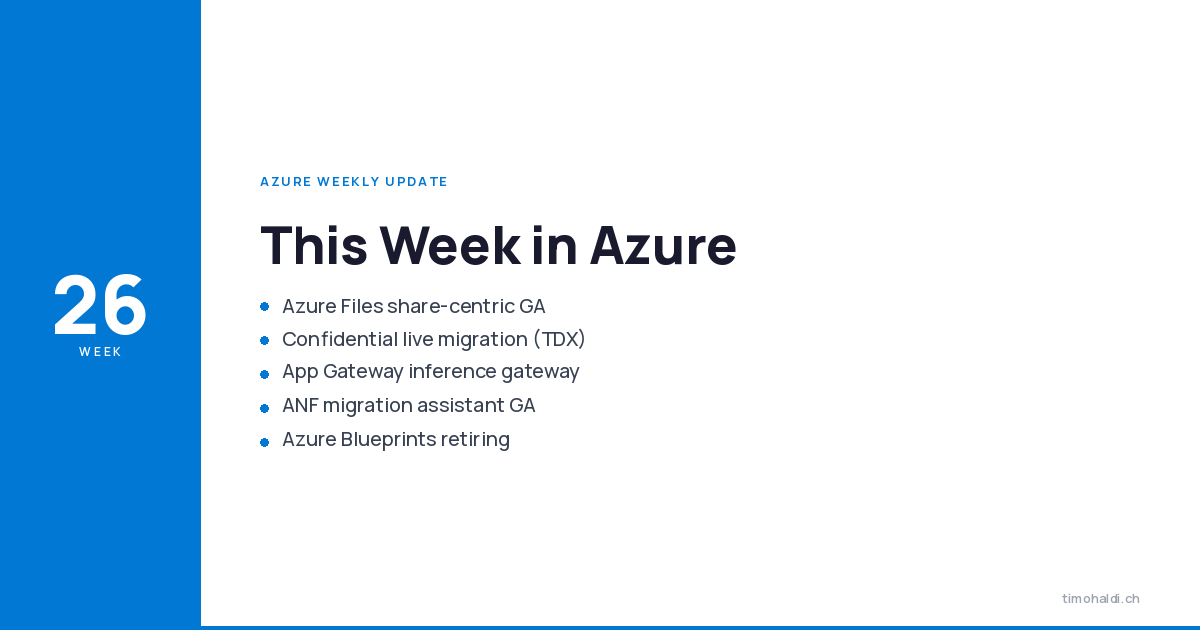
This week in Azure
A storage-heavy week, and a good one. John’s update runs through a short list, but two of the items are worth real attention. Azure Files gets its share-centric management model to general availability, so a file share is now a top-level Azure resource instead of something buried inside a storage account. And the Azure NetApp Files migration assistant reaches GA in the portal.
The rest is a mix of forward-looking and housekeeping. Confidential Live Migration for Intel TDX VMs is the interesting compute story. Application Gateway for Containers picks up an inference gateway for AI traffic. And two retirements landed that you want on a planning calendar: Azure Blueprints and the AVS AV36 node.
Storage
Azure Files: file share-centric management (Microsoft.FileShares) GA
The headline this week. Azure Files share-centric management is now generally available. A file share is deployed as an independent, top-level Azure resource through the new Microsoft.FileShares resource provider. No storage account in the middle.
That changes the shape of things. Each share gets its own performance, security, networking and billing, so you get proper isolation and cost tracking per share instead of bundling everything under one account. It also lifts scale: up to 10,000 shares per subscription per region, faster provisioning, and clean automation through ARM templates, Bicep and CI/CD.
The fine print: at GA this covers NFS 4.1 shares on SSD, using the provisioned v2 billing model with LRS and ZRS. So it’s not every workload yet, but if you run NFS file shares on Azure, this is the model to design new deployments around. Treating a share like a VM or a disk is the right abstraction. Check the service limits before you plan around the per-region share count.
Azure NetApp Files: migration assistant GA
The Azure NetApp Files migration assistant portal experience is now generally available. The REST API was already GA; the portal catches up.
It’s powered by ONTAP’s built-in SnapMirror replication, so it moves data from on-premises ONTAP or Cloud Volumes ONTAP into ANF efficiently, with storage-optimised baseline and incremental syncs and a short cutover window. It copies the whole volume: directories, files, file metadata (owner, creation and modified dates) and existing snapshots.
You need ONTAP 9.10.0 or later and a SnapMirror licence applied to the source cluster. If you’re moving NetApp workloads into Azure and you’d been scripting your own replication, this is the supported path now. Use it.
Compute
Confidential Live Migration for Intel TDX VMs
Confidential Live Migration, first shown at Build, moves Intel TDX confidential VMs onto updated infrastructure with limited interruption, and keeps the memory and execution context protected the whole way across.
Live migration is what lets Azure service hosts without dragging you through a maintenance window. Confidential VMs never had it, because you can’t just copy encrypted VM memory to another host and trust the destination. Intel’s architecture solves that with the MigTD, a small attested module that checks the destination against a migration policy and only allows the move when the target satisfies it.
This rolls out gradually for the DC/ECesv6 and DC/ECedsv6 series, with more detail promised ahead of GA. If you run confidential computing for finance, healthcare or any regulated workload, this is the piece that finally makes planned host servicing non-disruptive. Worth tracking, not yet something to schedule.
Networking and AI
Application Gateway for Containers: inference gateway
Application Gateway for Containers adds an inference gateway for AI traffic. It’s a layer-7 path that routes inference requests to self-hosted model servers running in AKS, configured through the Gateway API Inference Extension.
The point is model-aware routing. Instead of treating an inference request like any other HTTP call, it does request-time endpoint selection and uses an Endpoint Picker to send traffic to the least-loaded model replica, which keeps latency down when replicas are unevenly loaded. WAF sits in front for the usual protection.
If you’re self-hosting models on AKS and load-balancing them with a generic ingress today, this is purpose-built for the job. Azure runs the data plane outside the cluster, same as the rest of Application Gateway for Containers.
Retirements
Azure Blueprints retirement
Azure Blueprints, which never left preview, is being retired. Phased retirement begins July 31st, 2026, with full retirement on January 31st, 2027.
The migration path is Deployment Stacks (the recommended target) and Template Specs. Deployment Stacks give you the lifecycle-management piece Blueprints offered, managing a collection of resources as a single unit with deny-assignment protection against drift.
If you still have blueprint definitions and assignments in play, start moving them now. January isn’t far off once you account for testing the converted artefacts. If you’re rethinking your guardrails while you’re in there, my governance framework guide covers where policy, locks and deployment stacks each fit.
Azure VMware Solution AV36 node retirement
The AVS AV36 node type retires on June 30th, 2028. Not imminent, but the transition windows have nearer dates worth noting: existing AV36 pay-as-you-go subscriptions continue through September 30th, 2027, and AV36 VCF BYOL 1-year reservations are available until June 30th, 2026.
Existing AV36 reserved-instance terms aren’t affected by the announcement. The replacement SKUs are AV36P, AV48, AV52 and AV64, all with AVS VCF BYOL options. If you run AVS on AV36, map your reservation expiry against these dates and plan the node migration with your account team.
Final thoughts
One thing worth doing this week: if you run NFS file shares on Azure, look at the share-centric management model now that it’s GA. Per-share isolation, networking and billing is the abstraction you actually wanted, and new deployments should start there rather than under a storage account you’ll want to unpick later.
The ANF migration assistant going GA in the portal is the other practical one. If a NetApp migration into Azure has been sitting on the backlog because the tooling was half-finished, that excuse is gone.
The two retirements need calendar entries, not action today. Azure Blueprints is the more pressing of the two, full retirement January 31st, 2027, so get definitions onto Deployment Stacks well ahead of that. AVS AV36 is a 2028 problem, but if you hold reservations, the BYOL window closes end of June 2026. Confidential Live Migration and the App Gateway inference gateway are both worth a read now and a pilot when you next touch those workloads.
Sources
- John Savill, “Azure Update - 26th June 2026,” YouTube, https://www.youtube.com/watch?v=aSGmp859GSA
- “Simpler, scalable file share management in Azure - now generally available,” Azure Storage Blog, https://techcommunity.microsoft.com/blog/azurestorageblog/simpler-scalable-file-share-management-in-azure---now-generally-available/4523035
- “Create a file share (Microsoft.FileShares),” Microsoft Learn, https://learn.microsoft.com/en-us/azure/storage/files/create-file-share
- “Migrate volumes to Azure NetApp Files,” Microsoft Learn, https://learn.microsoft.com/en-us/azure/azure-netapp-files/migrate-volumes
- “Announcing Confidential Live Migration in Azure,” Microsoft Community Hub, https://techcommunity.microsoft.com/blog/azureconfidentialcomputingblog/announcing-confidential-live-migration-in-azure/4524558
- “What is Application Gateway for Containers?,” Microsoft Learn, https://learn.microsoft.com/en-us/azure/application-gateway/for-containers/overview
- “Overview of Azure Blueprints,” Microsoft Learn, https://learn.microsoft.com/en-us/azure/governance/blueprints/overview
- “Azure VMware Solution AV36 node retirement on June 30, 2028,” Azure Updates, https://azure.microsoft.com/en-us/updates/